
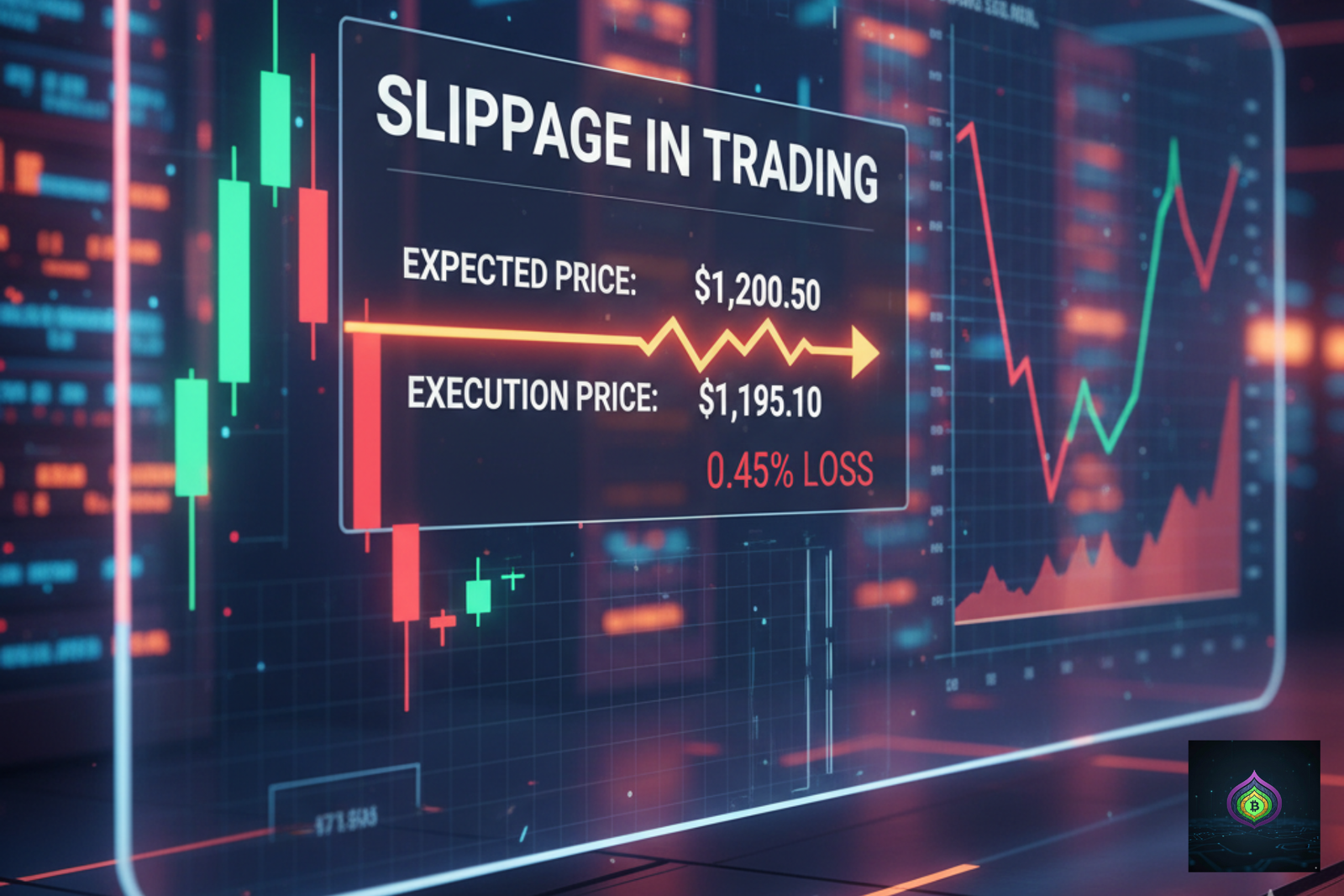
Slippage in trading refers to the difference between the expected price of a trade and the actual price at which it is executed on an exchange. This phenomenon occurs across all financial markets—including stocks, forex, commodities, and cryptocurrencies—and is especially common during periods of high volatility or low liquidity. Slippage is not inherently negative; it can be either positive slippage (better price than expected) or negative slippage (worse price than expected). However, most traders focus on minimizing negative slippage because it directly impacts profitability, execution accuracy, and risk management. In modern electronic markets where prices change in milliseconds, slippage has become a critical metric for evaluating execution quality.
Why Slippage Happens in Exchange Trading?
Slippage occurs primarily because markets are dynamic environments where prices move continuously. When a trader submits a market order, the exchange executes it at the best available price—not necessarily the displayed quote at the time of clicking “buy” or “sell.” If liquidity is thin or order size is large, the trade may be filled across multiple price levels in the order book. This results in an average fill price that differs from the original quote. Other causes include market volatility, order size, execution speed, network latency, and exchange liquidity depth. During major news events or sudden price spikes, slippage can increase dramatically because prices move faster than systems can match orders.
Why Does Slippage Occur?
Slippage happens because financial markets are dynamic, with prices constantly adjusting based on supply and demand. The main reasons include:
- High Market Volatility: When prices move rapidly, the time between placing an order and its execution can result in a different price. For example, during major economic announcements or geopolitical events, volatility spikes and slippage becomes more frequent.
- Low Liquidity: In markets or assets with fewer buyers and sellers, large orders cannot be matched at a single price. This forces partial fills across multiple price levels, creating slippage.
- Order Execution Speed: Even milliseconds matter in trading. Delays in order routing, broker systems, or exchange matching engines can cause slippage. High-frequency traders often invest heavily in technology to minimize this risk.
- Market Gaps: Overnight or weekend gaps, especially in forex and equities, lead to significant slippage when markets reopen at a different price than the previous close.
- Order Type: Market orders, which prioritize speed over price, are most vulnerable to slippage. Limit orders, on the other hand, protect traders by setting a maximum or minimum execution price, though they risk not being filled at all.
Key Features of Slippage Traders Must Know
Slippage has several defining characteristics that traders must understand to manage execution risk effectively. First, it is unavoidable in real-world trading because no market remains perfectly static. Second, it is more pronounced with market orders than limit orders, since market orders prioritize execution speed over price certainty. Third, slippage tends to rise in assets with low trading volume or wide bid-ask spreads, such as small-cap stocks or newly listed cryptocurrencies. Fourth, algorithmic and high-frequency traders often experience less slippage because they use advanced execution strategies designed to minimize market impact. Finally, slippage is a key performance indicator used by institutional traders to evaluate broker and exchange efficiency.
Types of Slippage in Financial Markets
There are three primary forms of slippage that occur on exchanges. Negative slippage happens when traders receive a worse price than expected, which is the most common scenario in fast-moving markets. Positive slippage occurs when execution happens at a better price, effectively giving traders an unexpected gain. Neutral slippage occurs when the executed price matches the quoted price exactly, typically in highly liquid markets with tight spreads. Understanding these distinctions helps traders interpret trade execution reports and refine strategies.
Key Statistics About Slippage Across Markets
Market data shows that slippage varies significantly depending on asset class, liquidity, and volatility conditions. The global foreign exchange market, which processes over $7 trillion in daily trading volume, typically experiences minimal slippage during stable conditions due to its deep liquidity. In contrast, cryptocurrency markets—especially low-cap tokens—can experience slippage exceeding 5–10% during volatile periods or large orders. Equity markets usually have tighter spreads, often just a few cents per share for liquid stocks, resulting in relatively small slippage for retail traders. However, during major announcements or market crashes, slippage spikes across all asset classes as liquidity temporarily disappears.
Statistical Insights
- In forex trading, slippage can average between 0.1 to 0.5 pips per trade under normal conditions, but during high volatility events like central bank announcements, slippage can spike to 5–10 pips or more.
- In equity markets, studies show that slippage can account for up to 30% of trading costs for high-frequency traders.
- Cryptocurrency exchanges, due to lower liquidity compared to traditional markets, often report slippage rates exceeding 1–3% of trade value during peak volatility.
The Impact of Slippage on Trading Performance
Slippage directly affects profitability, risk exposure, and strategy accuracy. For short-term traders such as scalpers or day traders, even small price differences can significantly alter results because their profit targets are often narrow. For institutional investors executing large orders, slippage can translate into thousands or millions of dollars in execution cost. Over time, repeated negative slippage can distort backtested results, making strategies appear profitable in theory but ineffective in live markets. This is why professional trading systems always factor realistic slippage assumptions into performance modeling.
Real Trade Examples of Slippage (With Calculations)
Example 1 — Stock Market Slippage (Market Order)
A trader places a market buy order for 500 shares of a stock quoted at:
- Bid: $50.00
- Ask: $50.05
However, the order book liquidity is:
| Shares Available | Price |
|---|---|
| 200 | $50.05 |
| 200 | $50.10 |
| 100 | $50.20 |
Execution Calculation
The order fills across price levels:
- 200 × 50.05 = $10,010
- 200 × 50.10 = $10,020
- 100 × 50.20 = $5,020
Total Cost = $25,050
Average execution price:25,050÷500=50.10
Expected price = $50.05
Actual price = $50.10
Slippage = $0.05 per share
Total slippage cost:0.05×500=$25
Example 2 — Crypto Trade Slippage
A trader submits a market buy for 2 BTC at an expected price of $40,000.
Liquidity in order book:
| BTC | Price |
|---|---|
| 0.5 | 40,000 |
| 0.5 | 40,200 |
| 1.0 | 40,600 |
Execution
- 0.5 × 40,000 = 20,000
- 0.5 × 40,200 = 20,100
- 1.0 × 40,600 = 40,600
Total paid = $80,700
Average price:80,700÷2=40,350
Expected = 40,000
Actual = 40,350
Slippage = $350 per BTC
Total slippage loss:350×2=700
Example 3 — Positive Slippage (Rare but Possible)
You place a limit sell at $100.
Market suddenly spikes and your order fills at $101.
Expected price = $100
Actual = $101
Positive slippage gain = $1 per share
Quick Formula Breakdown
Total Trading Cost = Spread + Slippage + Fees
Example:
| Component | Value |
|---|---|
| Spread | $20 |
| Slippage | $25 |
| Fees | $10 |
| Total Cost | $55 |
Most beginners only consider fees — but professional traders know hidden execution costs (spread + slippage) often exceed visible fees.
How Exchanges and Technology Influence Slippage?
Exchange infrastructure plays a major role in determining slippage levels. Platforms with deep liquidity pools, fast matching engines, and high throughput tend to produce better execution prices. Latency also matters—delays of even a few milliseconds can cause orders to be filled at different prices in rapidly moving markets. Advanced exchanges now use technologies such as smart order routing, co-location services, and liquidity aggregation to reduce execution delays and improve price accuracy. Traders using slower connections or outdated platforms are more likely to experience slippage because their orders reach the market later.
Comparison Table: Slippage vs Spread vs Fees
| Factor | Definition | When It Happens | Who Controls It | Impact on Profit | Predictability |
|---|---|---|---|---|---|
| Slippage | Difference between expected and executed price | During order execution | Market liquidity + speed | Variable | Low |
| Spread | Difference between bid and ask | Always present | Market makers/liquidity | Fixed at entry | Medium |
| Fees | Broker or exchange charges | Every trade | Exchange/Broker | Fixed cost | High |
Strategies Traders Use to Reduce Slippage
Professional traders apply several techniques to minimize slippage exposure. One of the most effective methods is using limit orders instead of market orders, which ensures trades execute only at a specified price or better. Another approach is trading during periods of high liquidity, such as major market sessions, when spreads are tight and order books are deep. Breaking large orders into smaller pieces—known as order slicing—reduces market impact and helps maintain favorable pricing. Many advanced traders also rely on algorithmic execution tools designed to optimize trade timing and routing.
Impact on Traders
Slippage is often called the “silent thief of profits” because it erodes returns without being immediately obvious. For day traders and scalpers, even small slippage can accumulate into significant losses. Institutional traders often employ advanced algorithms and smart order routing to minimize slippage, while retail traders can mitigate it by using limit orders, trading during high liquidity periods, and avoiding major news events.
Slippage in Algorithmic and Automated Trading
In algorithmic trading, slippage is a core parameter used to evaluate strategy performance. Trading bots and quantitative models incorporate estimated slippage into simulations to ensure realistic expectations. Algorithms may dynamically adjust order size, timing, or execution venue based on real-time liquidity data. Some systems even monitor historical slippage patterns to predict when execution conditions are most favorable. For automated traders, controlling slippage is just as important as predicting market direction, because execution efficiency directly affects net returns.
Final Thoughts: Why Slippage Matters for Every Trader
Slippage is a fundamental concept that every trader—from beginners to institutions—must understand to trade effectively on any exchange. It represents the real-world friction between theoretical prices and actual execution, and it can significantly influence profitability, especially in fast-moving or low-liquidity markets. By understanding its causes, monitoring its impact, and applying smart execution strategies, traders can reduce risk and improve consistency. In today’s high-speed digital markets, mastering slippage management is not optional—it is a core skill that separates disciplined traders from those who rely purely on price predictions.
FAQ
Q1: What is slippage in trading?
Slippage is the difference between the expected price of a trade and the actual execution price, often caused by market volatility or low liquidity.
Q2: Is slippage always negative?
No. Slippage can be positive (better price than expected) or negative (worse price). However, traders usually encounter negative slippage more often.
Q3: Which markets are most affected by slippage?
Slippage occurs in all markets—stocks, forex, commodities, and cryptocurrencies—but is most pronounced in highly volatile or low-liquidity environments.
Q4: How can traders reduce slippage?
Using limit orders, trading during high liquidity periods, and avoiding major news events are effective strategies to minimize slippage.
Q5: Why does slippage matter for traders?
Because it silently erodes profits and increases trading costs, especially for day traders and high-frequency strategies.
Q6: What Is a 2% Slippage?
2% slippage means your trade executes at a price up to 2% worse than the price you expected.
For example, if you place a buy order at $100 with 2% slippage tolerance, the trade could execute at up to $102.
It usually happens due to price volatility or low liquidity in the market.
Q7: Is Positive Slippage Good?
Yes, positive slippage is good.
It means your trade executes at a better price than expected — for example, you buy for less or sell for more than the price you set.
Q8: How can traders reduce the risk of slippage?
Traders can reduce slippage by:
- Using limit orders instead of market orders
- Trading during high-liquidity periods
- Avoiding high volatility times (e.g., major news)
- Choosing markets with tight spreads