A plain-English breakdown for traders, DeFi users, and crypto curious minds — no jargon overload, just the truth.
You’ve probably seen WBTC pop up on DeFi platforms and wondered — isn’t that just Bitcoin? Why does it exist? Is it safe? Can I trade it like regular BTC?
Great questions. And the answers matter — especially if you’re actively trading crypto, using a DeFi protocol, or managing assets across multiple wallets. The Bitcoin vs Wrapped Bitcoin conversation is one of the most important in the crypto space right now, yet it’s consistently misunderstood.
Let’s break it down clearly, honestly, and with zero fluff. By the end of this article, you’ll know exactly what WBTC is, why it was created, how it works, and whether it’s the right tool for your crypto strategy.
First, Let’s Talk About Bitcoin (BTC)
Bitcoin needs little introduction. Launched in 2009 by the pseudonymous Satoshi Nakamoto, it’s the original cryptocurrency and still the largest by market capitalization. Bitcoin runs on its own blockchain — a decentralized, proof-of-work network secured by miners around the world.
Bitcoin is designed to be digital gold: a scarce, censorship-resistant store of value. Its supply is capped at 21 million BTC — forever. And it’s notoriously stubborn about adding new features, which is actually a feature, not a bug. That conservatism is what makes it trustworthy.
But here’s Bitcoin’s big limitation:
- Bitcoin’s blockchain cannot run smart contracts natively
- It has no access to Ethereum’s DeFi ecosystem
- You can’t use BTC directly on Uniswap, Aave, Compound, or most DEXs
- Bitcoin and Ethereum live on completely separate blockchains with no native bridge
This is exactly the problem Wrapped Bitcoin was invented to solve.
So, What Is Wrapped Bitcoin (WBTC)?
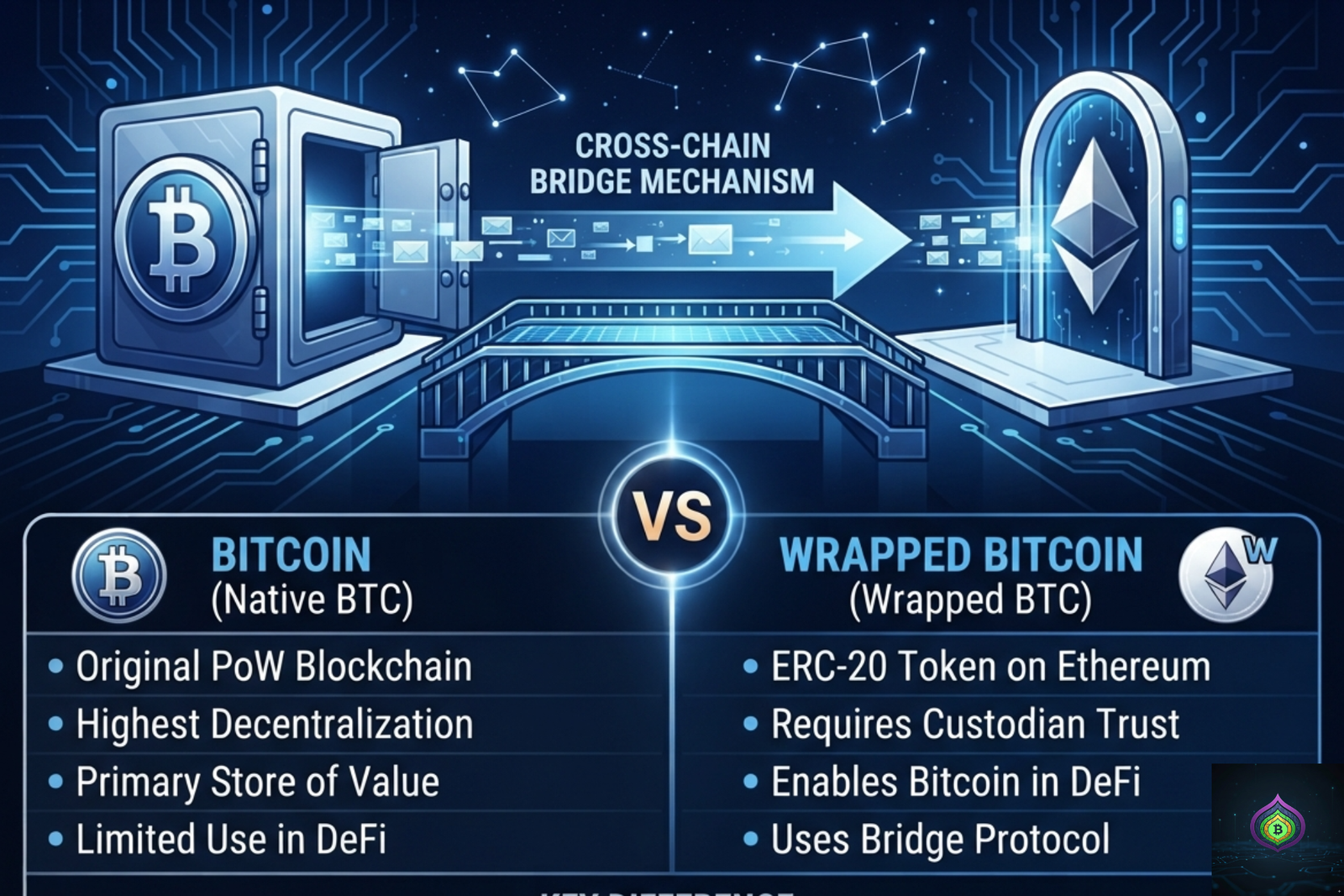
Wrapped Bitcoin (WBTC) is an ERC-20 token on the Ethereum blockchain that is pegged 1:1 to Bitcoin. Every single WBTC in circulation is backed by one real Bitcoin held in reserve by a custodian.
Think of it like a gold-backed certificate. The gold (BTC) stays locked in a vault, and you receive a paper certificate (WBTC) that you can freely trade, lend, and use in DeFi applications — all while retaining the full value of your Bitcoin.
WBTC was launched in January 2019 through a collaboration between BitGo, Ren, and Kyber Network. Today it’s governed by the WBTC DAO and secured by BitGo as the primary custodian. It has grown into one of the most widely used tokens in the Ethereum DeFi ecosystem.
📊 Did You Know? As of 2024, there are over 150,000 WBTC in circulation, representing billions of dollars of Bitcoin liquidity flowing through the Ethereum DeFi ecosystem — all made possible by the wrapping mechanism.
How Does the Wrapping Process Actually Work?
This is where it gets interesting — and once you understand the mechanics, you’ll appreciate how clever (and how trust-dependent) WBTC really is.
Step-by-Step: BTC → WBTC
- You send Bitcoin to a WBTC merchant (an authorized gateway institution)
- The merchant verifies your identity through KYC/AML checks
- The merchant submits a minting request to BitGo, the custodian
- BitGo locks your BTC in a multi-signature wallet and mints the equivalent WBTC on Ethereum
- You receive WBTC in your Ethereum wallet — ready for DeFi use
Step-by-Step: WBTC → BTC (Unwrapping)
- You send WBTC back to the merchant with a burn request
- The merchant initiates the burn — destroying those WBTC tokens on Ethereum
- BitGo releases the equivalent BTC from the reserve
- Your Bitcoin is returned to your wallet
The entire process is verifiable on-chain. You can check the BTC reserves backing WBTC at any time using public blockchain explorers — a level of transparency that gives users significant confidence in the peg.
🔐 Security Note: WBTC reserves are held in multi-signature wallets, requiring multiple cryptographic approvals for any movement of funds. This is the same enterprise-grade custody used by major crypto exchanges for cold storage.
Bitcoin vs Wrapped Bitcoin: Side-by-Side Comparison
Here’s a clear at-a-glance comparison of BTC and WBTC across the metrics that matter most to traders and DeFi users:
| Feature | Bitcoin (BTC) | Wrapped Bitcoin (WBTC) |
| Blockchain | Bitcoin Network | Ethereum (ERC-20) |
| Use in DeFi | ❌ Limited | ✅ Full Access |
| Custody | Self-custody / exchange | Custodian (BitGo) |
| Pegged Value | N/A — it is BTC | 1:1 to BTC |
| Gas Fees | Bitcoin network fees | Ethereum gas fees |
| Smart Contract | ❌ Not native | ✅ EVM compatible |
| Liquidity | Bitcoin DEXs only | All Ethereum DEXs & DeFi |
| Minting | N/A | Via merchants + custodian |
Why Would Anyone Choose WBTC Over BTC?
This is the crux of it. Both assets trade at essentially the same price — so why would you ever want WBTC instead of the real thing?
1. Access to DeFi Yield
This is the #1 reason. With WBTC, Bitcoin holders can put their assets to work. You can lend WBTC on Aave or Compound to earn interest, provide liquidity on Uniswap or Curve, use it as collateral to borrow stablecoins, and participate in yield farming strategies — all impossible with native BTC.
2. Trading Flexibility
WBTC can be traded on any Ethereum-based DEX, opening access to thousands of trading pairs. For active traders, this means more liquidity venues, tighter spreads, and seamless swaps within the Ethereum ecosystem — without the friction of moving between chains.
3. Smart Contract Integration
Developers building DeFi protocols, derivatives platforms, or structured products need tokens that work natively with Ethereum smart contracts. WBTC brings Bitcoin’s liquidity into these environments without requiring users to abandon the BTC price exposure they want.
4. Portfolio Consolidation
Traders who want to keep everything on one chain — Ethereum — can hold Bitcoin exposure via WBTC without managing a separate Bitcoin wallet, seed phrase, and wallet interface. For active DeFi participants, simplifying the stack has real operational value.
What Are the Risks of Wrapped Bitcoin?
Nothing in crypto comes without trade-offs, and WBTC is no exception. Before you wrap your BTC, understand these risks:
- Custodial Risk: Your BTC is held by BitGo. This is centralized custody — the opposite of Bitcoin’s trustless ethos. If BitGo were compromised, hacked, or insolvent, the peg could break.
- Smart Contract Risk: WBTC exists as code on Ethereum. Bugs or exploits in the ERC-20 contract or integrated DeFi protocols represent an attack surface that native BTC doesn’t have.
- Regulatory Risk: Because WBTC minting requires KYC, it’s subject to regulatory oversight. A regulatory crackdown on custodians could freeze minting/burning operations.
- Peg Risk: While the 1:1 peg has held reliably since 2019, it is not guaranteed. During extreme market dislocations or a custodian crisis, WBTC could theoretically trade at a discount to BTC.
- Ethereum Network Congestion: Using WBTC in DeFi requires paying Ethereum gas fees, which can be expensive during high-activity periods.
Key Takeaway: WBTC is not the same as holding Bitcoin. It offers powerful utility but introduces custodial and smart contract risks that native BTC does not. Understand what you’re giving up before wrapping.
Bitcoin vs Wrapped Bitcoin: Which Should You Use?
The honest answer is: it depends on your goals. Neither is universally better — they serve different purposes in a crypto strategy.
- Use BTC if: You want maximum security, self-custody, and long-term store of value. Bitcoin is the safer, more decentralized option for HODLers who don’t need DeFi access.
- Use WBTC if: You’re an active DeFi user who wants to earn yield on Bitcoin exposure, use BTC as collateral, or trade seamlessly within the Ethereum ecosystem.
- Use both if: You’re a sophisticated trader who holds core BTC in cold storage while deploying a portion as WBTC in yield-generating DeFi positions.
Many professional crypto portfolio managers do exactly this — treating BTC as their foundation and WBTC as an active, yield-generating layer on top.
🔗 Ready to Put Your Bitcoin to Work?
Understanding Bitcoin vs Wrapped Bitcoin is just the beginning. The real opportunity is in knowing how to deploy these assets strategically — whether that’s earning yield in DeFi, trading on decentralized exchanges, or building a multi-chain portfolio that maximizes every satoshi.
The crypto space rewards the informed. The more you understand about how assets like WBTC work, the better positioned you are to make smarter decisions — and avoid costly mistakes.
✅ Research reputable WBTC merchants before wrapping any BTC.
✅ Always verify on-chain reserves before using WBTC in DeFi protocols.
✅ Never put more in DeFi than you can afford to lose to smart contract risk.
Share this article with your trading community and help others navigate the BTC vs WBTC conversation with confidence. Knowledge is the best risk management tool in crypto.
Frequently Asked Questions
1. Is Wrapped Bitcoin the same price as Bitcoin?
Yes — WBTC is designed to maintain a 1:1 peg with Bitcoin at all times. In practice, it trades at virtually the same price, with only tiny deviations due to market liquidity. The peg is maintained by the minting and burning mechanism: if WBTC trades at a discount, arbitrageurs buy WBTC and burn it for BTC, restoring the peg.
2. Is Wrapped Bitcoin safe?
WBTC has maintained its peg reliably since 2019, and its reserves are publicly verifiable on-chain. However, it carries custodial risk (trusting BitGo) and smart contract risk. It is not as secure as holding native Bitcoin in self-custody. Whether it’s “safe enough” depends entirely on your risk tolerance and how you plan to use it.
3. Can I convert Wrapped Bitcoin back to Bitcoin?
Yes. The process is called “unwrapping” or “burning” WBTC. You submit a burn request through an authorized WBTC merchant, the tokens are destroyed on the Ethereum blockchain, and the equivalent BTC is released from BitGo’s custody back to your Bitcoin wallet. The process typically takes a few hours to complete.
4. What happens to my WBTC if BitGo goes bankrupt?
This is a genuine risk. BitGo holds the underlying BTC as custodian. If BitGo became insolvent, WBTC holders could face difficulties recovering their underlying Bitcoin. The WBTC DAO has governance structures in place to transition custodians if necessary, but this represents real counterparty risk that doesn’t exist with native BTC. Always account for this in your risk management.
5. Are there alternatives to Wrapped Bitcoin for using BTC in DeFi?
Yes. Alternatives include renBTC (now largely deprecated), tBTC (maintained by Threshold Network with a more decentralized custody model), and various cross-chain bridges that allow Bitcoin exposure on other blockchains like Solana or Avalanche. Each has different trust models, liquidity levels, and risk profiles. WBTC remains the most liquid and widely integrated option as of 2024.