No jargon, no hype, no shortcuts. Just an honest, practical guide to buying your first Bitcoin — safely, strategically, and with full confidence.
You’ve heard about Bitcoin for years. Maybe you’ve watched friends make life-changing gains. Maybe you’ve seen it crash and wondered if it’s too risky. Maybe you’re simply curious about what all the fuss is. Whatever brought you here, the fact that you’re reading this guide means you’re taking your first step — and the best time to start is when you’re properly informed.
Getting started with Bitcoin investing doesn’t have to be complicated. But it does require making a few smart decisions upfront — about where you buy, how you store it, how much you invest, and what your strategy actually is. This guide walks you through every step, in plain English, with no assumptions about your prior knowledge.
Before You Invest: Understand What You’re Actually Buying
Bitcoin (BTC) is a decentralized digital currency created in 2009. Its supply is permanently capped at 21 million coins — a hard limit enforced by cryptographic mathematics, not by any government or company. This fixed supply, combined with growing global demand, is the foundational reason many investors view Bitcoin as a long-term store of value similar to digital gold.
Unlike stocks (which represent ownership in a company that generates revenue) or bonds (which pay interest), Bitcoin’s value comes from its scarcity, decentralization, network security, and growing adoption as a global, permissionless monetary network. It is volatile — price swings of 30–80% are historically normal — and that volatility is the price of its long-term upside potential.
Understanding what Bitcoin is and isn’t helps you invest with the right mindset:
- Bitcoin is not a get-rich-quick scheme — it’s a long-term asymmetric bet on a decentralized monetary network
- Bitcoin is not a company — it has no earnings, no dividends, no CEO, and no bankruptcy risk
- Bitcoin is not anonymous — transactions are publicly recorded on a transparent blockchain
- Bitcoin is not insured by the government — losses from poor custody decisions are permanent
📌 The Core Investment Case: Since its creation in 2009, Bitcoin has been the best-performing asset of any decade — outperforming stocks, gold, real estate, and every other major asset class over 10-year periods. Past performance doesn’t guarantee future results, but its track record is unmatched.
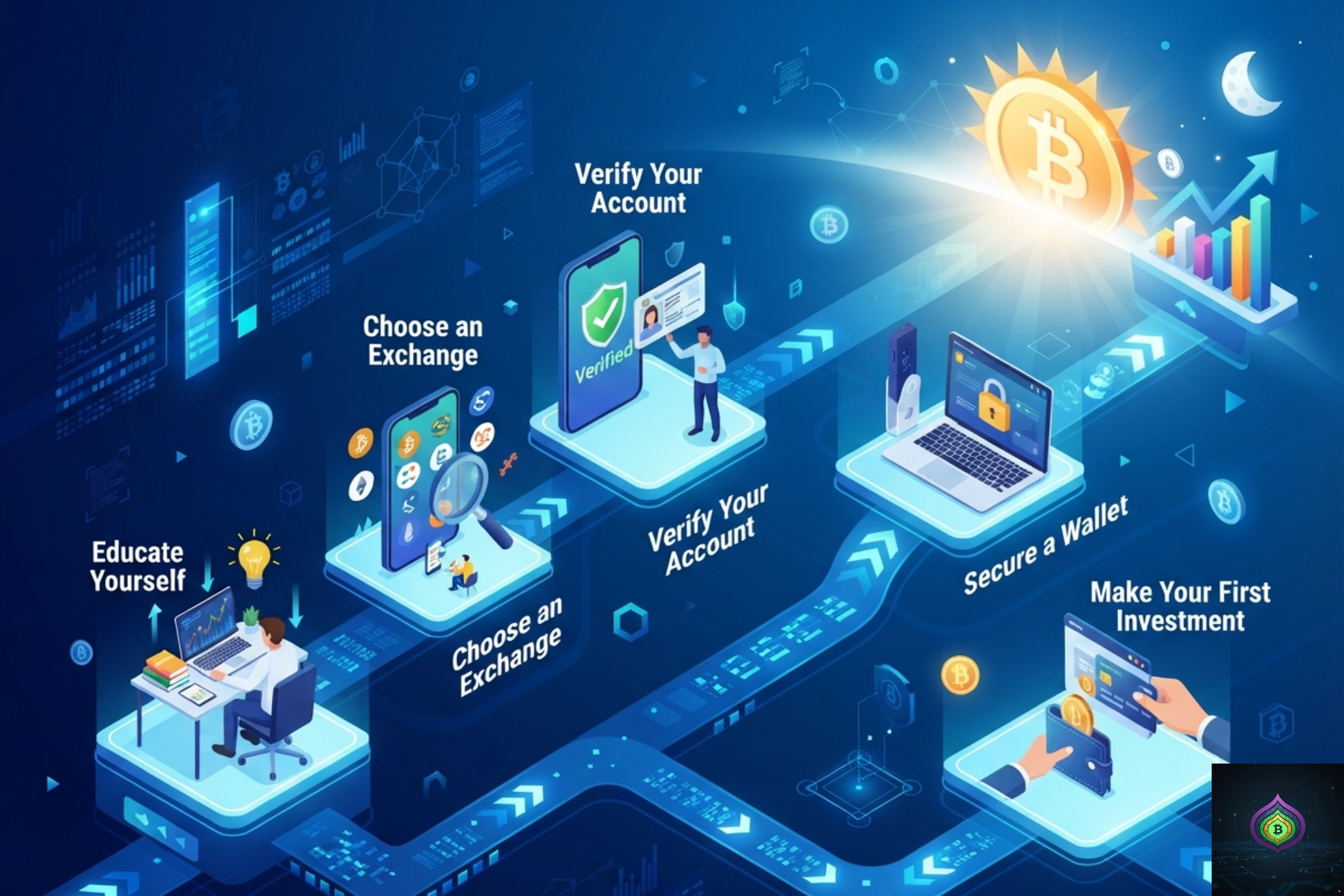
The 7-Step Roadmap to Getting Started With Bitcoin Investing
Step 1: Define Your Investment Goals and Risk Tolerance
Before you buy a single satoshi, get clear on why you’re investing in Bitcoin. Your strategy, timeline, and position size all flow from this. Ask yourself:
- Am I investing for long-term wealth preservation against inflation?
- Am I speculating on short-to-medium term price appreciation?
- Am I diversifying an existing investment portfolio?
- How would I feel if my Bitcoin position lost 50% of its value tomorrow?
Bitcoin can represent different things for different investors. A retirement-focused investor might allocate 1–5% of their portfolio as a hedge. A younger, higher-risk-tolerance investor might allocate 10–20%. A Bitcoin maximalist might go all-in. None of these is universally right — the right allocation is the one that lets you sleep at night without panic-selling at the worst time.
Step 2: Choose a Reputable Exchange
Your Bitcoin journey begins at a cryptocurrency exchange — a regulated platform where you create an account, verify your identity, and purchase BTC with fiat currency (USD, EUR, GBP, etc.). Choosing the right exchange matters enormously for security, fees, and user experience.
Top exchanges for Bitcoin beginners and experienced investors in 2026:
- Coinbase: Best for US beginners — regulated, insured, simple interface; higher retail fees but lowest learning curve
- Kraken: Excellent security track record, competitive fees, US and EU-regulated; slightly steeper learning curve
- Gemini: New York-regulated, SOC 2 certified, conservative and trustworthy; great for compliance-focused investors
- Binance: Most liquidity globally, lowest fees, widest feature set; more complex, some regulatory friction in certain markets
- Cash App: Easiest mobile entry point; Bitcoin-only, simple, Square-backed; limited features
✅ Security First: Only use exchanges that require identity verification (KYC), have a strong regulatory standing, and ideally have been operating for 5+ years. Avoid unregulated platforms, offshore exchanges with no track record, and any exchange that offers returns that sound too good to be true.
Step 3: Complete Identity Verification (KYC)
All reputable exchanges are required by law to verify your identity before allowing you to buy Bitcoin. This process — called Know Your Customer (KYC) — typically involves submitting a government-issued ID (passport or driver’s licence) and a selfie. In most cases, approval is instant or takes a few hours.
Don’t skip this step or try to circumvent it. KYC protects the exchange from fraud and money laundering, and it protects you by ensuring your account can be recovered if you lose access. Exchanges without KYC requirements should be avoided — they typically lack the regulatory oversight that keeps your funds safe.
Step 4: Fund Your Account
Once verified, you need to add funds to your exchange account. You have several options, each with different costs and speeds:
- Bank transfer (ACH/SEPA): Cheapest option — often free or very low cost; takes 1–5 business days but many platforms offer instant buying power
- Debit card: Fast and convenient; fees typically 1.5–3.5%; uses money you already have — preferred over credit cards
- Wire transfer: Best for large amounts; fixed fee; 1–2 business days
- Credit card: Fastest but most expensive — 2.5–5% fees plus potential cash advance charges from your bank; not recommended for most investors
⚠️ Avoid Credit Cards: Buying Bitcoin with a credit card means buying a volatile asset with borrowed money at high interest rates. If Bitcoin drops significantly, you’re left paying interest on a depreciating position. Use money you own — not borrowed money.
Step 5: Buy Bitcoin — Starting Small Is Smart
You don’t need to buy a whole Bitcoin. Bitcoin is infinitely divisible — the smallest unit is a satoshi (0.00000001 BTC). Most exchanges allow purchases starting at just $1–$10. Starting small lets you learn the process without significant financial risk.
For most new investors, the single best strategy isn’t trying to time the market — it’s Dollar-Cost Averaging (DCA). DCA means buying a fixed dollar amount of Bitcoin on a regular schedule (weekly, bi-weekly, or monthly) regardless of the current price. This approach automatically buys more BTC when prices are low and less when they’re high, smoothing out your average cost over time.
📊 DCA in Action: If you invested $100 per month in Bitcoin every month from January 2020 to January 2024 — through crashes, recoveries, and the 2022 bear market — your total investment of $4,800 would have grown to approximately $14,000+ by early 2024, a gain of nearly 200% despite investing through one of the worst crypto bear markets in history.
Step 6: Set Up Secure Storage — This Is Critical
Buying Bitcoin is only half the equation. Where you store your Bitcoin is equally important — and this is where most beginners make costly mistakes. There are two fundamental options:
Custodial Storage (Exchange Wallet)
Leaving your Bitcoin on the exchange means the exchange holds the private keys. This is convenient and fine for small amounts or active traders — but it introduces custodial risk. If the exchange is hacked, goes bankrupt, or freezes your account, access to your Bitcoin could be compromised. The FTX collapse of 2022 saw billions in customer funds permanently lost.
Self-Custody (Personal Wallet)
A hardware wallet — such as a Ledger Nano X, Trezor Model T, or Coldcard — gives you direct control over your private keys. Your Bitcoin is stored offline, inaccessible to hackers, and not dependent on any company’s solvency. For any amount you plan to hold long-term, self-custody is the industry standard recommendation.
✅ Rule of Thumb: If you’re holding Bitcoin worth more than one month’s salary — or anything you’d genuinely miss if it disappeared — invest in a hardware wallet. They cost $70–$200 and are the most important security purchase a Bitcoin investor can make.
Step 7: Learn, Track, and Hold With Conviction
The final step is the most ongoing: continuous education and disciplined holding. Bitcoin’s price is extraordinarily volatile in the short term, and the single biggest mistake most new investors make is panic-selling during a crash. Every Bitcoin bear market in history has been followed by a new all-time high.
- Track your portfolio on CoinGecko, CoinMarketCap, or Delta app
- Follow on-chain analytics via Glassnode, CryptoQuant, or LookIntoBitcoin
- Stay informed through Bitcoin Magazine, What Bitcoin Did podcast, or Unchained
- Never sell based on short-term news cycles or fear — make decisions based on your original investment thesis
Which Strategy Fits You? A Quick Reference Guide
Use this table to identify the approach best aligned with your goals:
| Investor Type | Strategy | Time Horizon | Risk Tolerance | Recommended Entry |
| Complete Beginner | DCA Monthly | 3–5+ years | Low–Medium | Coinbase / Cash App |
| Active Trader | Technical + Swing | Weeks–Months | High | Kraken / Binance |
| Long-Term HODLer | Buy & Cold Store | 5–10+ years | Medium | Any + Hardware Wallet |
| Income Investor | ETF / Derivatives | Flexible | Medium | Fidelity FBTC / IBIT |
| High-Net-Worth | OTC + Institutional | 3–10 years | Medium | Coinbase Prime / Fidelity |
5 Common Mistakes New Bitcoin Investors Make — And How to Avoid Them
- Investing more than they can afford to lose: Bitcoin can drop 80%. Only invest money whose complete loss would not derail your financial life
- Leaving large amounts on exchanges: Use a hardware wallet for significant holdings — exchanges are trading venues, not vaults
- Trying to time the market: Professional traders with years of experience can’t reliably time Bitcoin’s moves. DCA beats market timing for most retail investors
- Falling for scams: No legitimate opportunity promises guaranteed Bitcoin returns, offers to double your BTC, or asks for your seed phrase. If someone does — it’s a scam, always
- Panic selling during crashes: Every Bitcoin crash in history has eventually reversed. Selling at the bottom locks in losses and removes you from the recovery
⚠️ The Seed Phrase is Sacred: When you set up a hardware wallet, you’ll receive a 12 or 24-word seed phrase. Write it down on paper. Store it securely offline. Never type it into any website, share it with anyone, or store it digitally. Anyone with your seed phrase can steal your Bitcoin — permanently.
Your Bitcoin Journey Starts With One Decision
Getting started with Bitcoin investing is simpler than most people think — and more powerful than most people realize. You don’t need to understand every technical detail. You don’t need to invest a fortune. You just need to take the first step with clear eyes, a sound strategy, and the patience to let time work in your favour.
The investors who built life-changing wealth with Bitcoin weren’t necessarily the smartest or the most technical. They were the ones who started early, invested consistently, held through the volatility, and secured their coins properly. Those principles are available to everyone — including you.
- Choose a reputable, regulated exchange and complete your KYC today.
- Set up automatic monthly DCA purchases — remove emotion from the equation.
- Order a hardware wallet and move your long-term holdings to self-custody.
- Only invest what you can afford to hold through a 50–80% drawdown without panic.
👉 Share this guide with someone who’s been curious about Bitcoin but doesn’t know where to start — because the best investment is an informed one.
Frequently Asked Questions
1. How much should I invest in Bitcoin as a beginner?
Most financial advisors suggest allocating no more than 1–10% of your investable assets to Bitcoin as a starting point, depending on your risk tolerance and time horizon. More importantly: only invest money whose complete loss would not significantly impact your financial situation. Bitcoin is highly volatile and has historically experienced 50–80% drawdowns. Starting with a small amount you’re comfortable with — even $50 or $100 — and gradually increasing through DCA is a sensible approach for most beginners.
2. Do I need to buy a whole Bitcoin to get started?
Absolutely not. Bitcoin is divisible to 8 decimal places — the smallest unit is called a satoshi (0.00000001 BTC). You can buy any fraction of a Bitcoin, starting from as little as $1–$5 on most exchanges. At a Bitcoin price of $63,000, $100 buys you approximately 0.00159 BTC (159,000 satoshis). There is no minimum ownership requirement — you participate in Bitcoin’s price movement proportionally to however much you own.
3. Is Bitcoin investing taxable?
In most jurisdictions, yes. In the United States, the IRS treats Bitcoin as property, meaning capital gains tax applies when you sell, trade, or use Bitcoin for purchases. Short-term gains (held less than 1 year) are taxed as ordinary income; long-term gains (held over 1 year) are taxed at lower capital gains rates (0%, 15%, or 20% depending on income). Most countries have similar frameworks, though specifics vary. Keep detailed records of all purchases, sales, and transfers. Using crypto tax software (Koinly, TaxBit, CoinTracker) simplifies reporting significantly.
4. What is Dollar-Cost Averaging (DCA) and why is it recommended?
Dollar-Cost Averaging means investing a fixed amount at regular intervals — weekly, bi-weekly, or monthly — regardless of Bitcoin’s current price. Instead of trying to predict the perfect time to buy (which even professionals can’t do reliably), DCA spreads your entry across many price points, reducing the impact of volatility on your average purchase price. It removes emotion from the investment process, prevents you from buying a single large position at a market peak, and builds the discipline of consistent investing over time. Most exchanges offer automated recurring purchase features to make this effortless.
5. What’s the difference between a hot wallet and a cold wallet?
A hot wallet is a crypto wallet connected to the internet — this includes your exchange account balance, mobile wallet apps, and browser extension wallets. Hot wallets are convenient for frequent transactions but are more vulnerable to online attacks. A cold wallet (or cold storage) is a crypto wallet kept offline — typically a hardware wallet like a Ledger or Trezor device. Cold wallets store your private keys in secure hardware that never connects to the internet, making them resistant to remote hacking. For long-term Bitcoin holdings, cold storage is the security standard recommended by every serious crypto security expert.