One is the foundation. The other is the expressway built on top. Here’s why both matter — and why together they could change how the world pays.
Imagine Bitcoin as a bustling city. The main roads are wide, solid, and built to last — but during rush hour, they get congested, and crossing town takes time and money. Now imagine a network of fast, private express lanes built above those roads, letting you zip across the city in seconds for almost nothing. That’s the simplest way to understand the relationship between the Bitcoin network and Lightning Network.
Both are real. Both are live. Both use real Bitcoin. But they serve very different purposes — and understanding the difference is essential for anyone who trades crypto, uses a Bitcoin wallet, or wants to understand where digital payments are heading.
So let’s break it down clearly, from the ground up — no jargon walls, just honest explanations and practical context.
The Bitcoin Network — The Bedrock of Everything
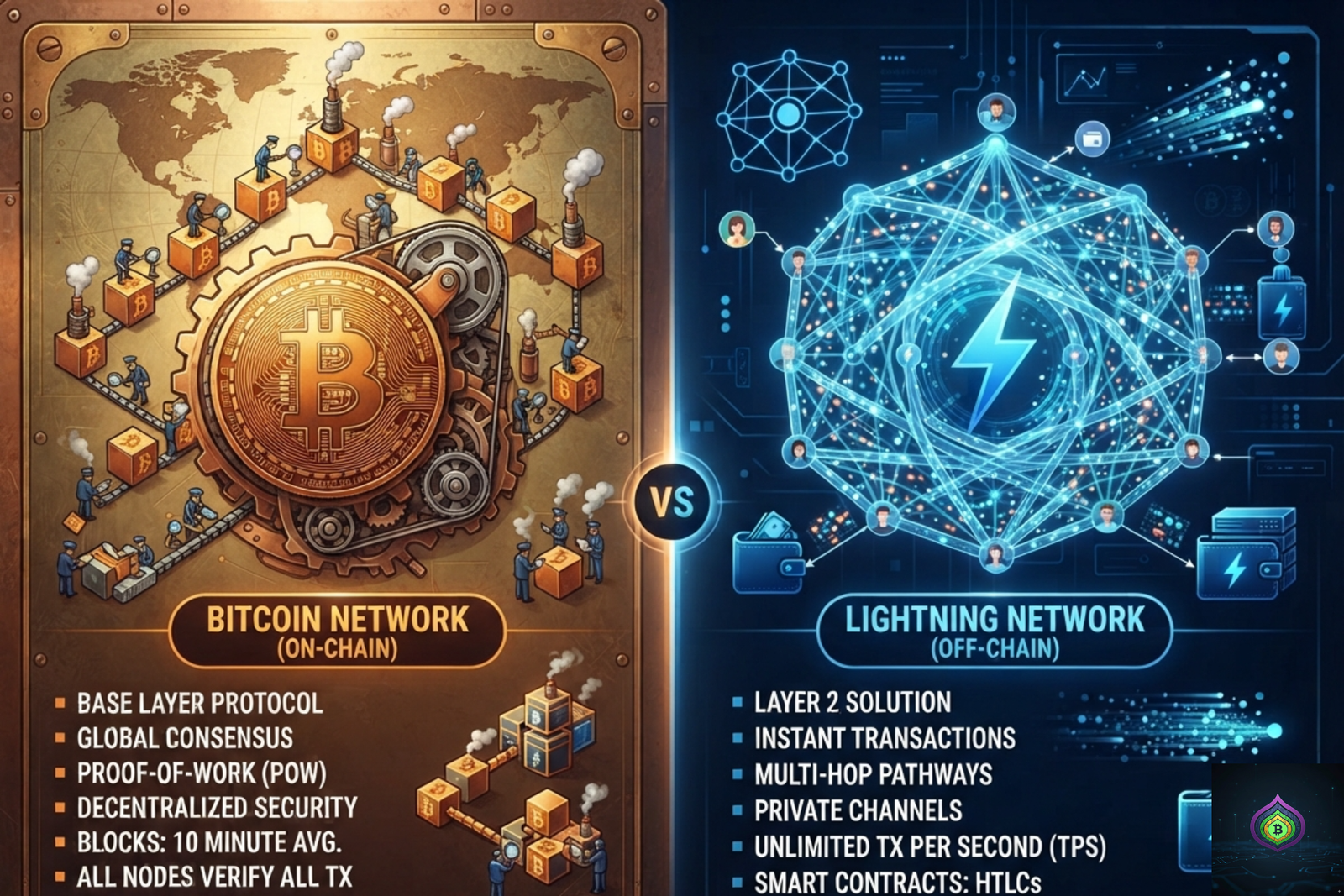
The Bitcoin network — often called Layer 1 (L1) — is the original blockchain created by Satoshi Nakamoto in 2009. It is a decentralized, public ledger where every confirmed Bitcoin transaction is permanently recorded by a global network of miners using Proof-of-Work (PoW) consensus.
Here’s how it works in practice: when you send Bitcoin from your wallet to another address, that transaction is broadcast to the network, grouped with other transactions into a block, and then confirmed by miners who solve a complex mathematical puzzle. This process takes an average of 10 minutes per block and typically requires multiple confirmations (3–6) before a transaction is considered truly final and irreversible.
The Bitcoin network is extraordinarily secure, battle-tested, and decentralized. No single party controls it. No government can shut it down. And every transaction ever made is permanently visible on the public blockchain. These are enormous strengths. But they come with trade-offs.
Bitcoin’s Layer 1 limitations are real and significant:
- Speed: ~7 transactions per second (TPS) — compared to Visa’s ~24,000 TPS
- Fees: Variable and market-driven — can spike to $30+ during high congestion
- Finality: You typically wait 10–60 minutes for a transaction to be considered settled
- Scalability: The 1 MB block size limits how many transactions fit in each block
- Practicality: Paying $15 in fees to buy a $5 coffee makes no economic sense
Key Fact: Bitcoin’s design constraints are intentional — they preserve decentralization and security. The trade-off is throughput. This is exactly why second-layer solutions like the Lightning Network were developed: not to replace Bitcoin, but to complement it.
The Lightning Network — Bitcoin at the Speed of Light
The Lightning Network is a Layer 2 payment protocol built on top of the Bitcoin blockchain. It was proposed by Joseph Poon and Thaddeus Dryja in a 2016 white paper and launched on Bitcoin’s mainnet in 2018. The core idea is elegantly simple: what if two parties could transact with each other multiple times off-chain, and only settle the final balance on the Bitcoin blockchain?
Instead of recording every single transaction on-chain (which is slow and expensive), the Lightning Network allows participants to open a payment channel — a private, direct line of credit between two parties — secured by a smart contract on the Bitcoin blockchain. Within that channel, they can send funds back and forth instantly, as many times as they want, with near-zero fees. When they’re done, they close the channel, and only the final balance is recorded on-chain.
And here’s the clever part: you don’t need a direct channel to someone to pay them. Payments are routed through a network of interconnected channels — like water finding its path through a river system. As long as there’s a connected path between sender and receiver, Lightning finds it automatically.
⚡ Lightning in Numbers: The Lightning Network can theoretically handle millions of transactions per second. Average payment fees are measured in satoshis (fractions of a cent). Payments complete in under a second. And every satoshi that moves through Lightning is real Bitcoin — not a derivative or a token.
Bitcoin Network vs Lightning Network: Full Comparison
Here’s a complete side-by-side look at how the two layers differ across every dimension that matters to users, traders, and developers:
| Feature | Bitcoin Network (L1) | Lightning Network (L2) |
| Layer | Layer 1 — Base Chain | Layer 2 — Built On Bitcoin |
| Transaction Speed | ~10 minutes per block | Milliseconds to seconds |
| Transaction Fees | Variable ($0.50–$30+) | Fractions of a cent |
| Throughput | ~7 TPS | Millions TPS (theoretical) |
| Settlement | On-chain (permanent) | Off-chain (settled on close) |
| Security Model | Proof-of-Work miners | Inherits Bitcoin’s security |
| Best For | Large / high-value transfers | Micropayments & daily spending |
| Reversibility | Irreversible once confirmed | Channel disputes possible |
| Requires BTC? | ✅ Yes | ✅ Yes (locked in channels) |
| Wallet Support | Universal | Growing (Breez, Phoenix, Muun) |
| Liquidity Needed? | ❌ No | ✅ Yes (inbound liquidity) |
How Payment Channels Actually Work?
Let’s walk through a real Lightning transaction so it clicks intuitively.
Step 1: Open a Channel
Alice wants to frequently pay Bob (a coffee shop). She opens a Lightning channel with Bob by creating a special multi-signature Bitcoin transaction that locks a certain amount of BTC — say, 0.01 BTC — into the channel. This is recorded on the Bitcoin blockchain. It costs a standard on-chain fee, but it’s a one-time cost.
Step 2: Transact Off-Chain
Now Alice can pay Bob as many times as she wants — 500 coffees, micropayments, tips — instantly and for virtually zero fees. Each transaction updates the channel balance between them. None of these are recorded on the blockchain. They’re private, fast, and free.
Step 3: Close the Channel
When Alice and Bob are done, they close the channel. The final balance — let’s say Alice has 0.004 BTC left and Bob has 0.006 BTC — is broadcast to the Bitcoin blockchain as a single transaction. One on-chain fee covers hundreds or thousands of payments.
Routing: No Direct Channel Required
Alice doesn’t need a direct channel with every merchant she wants to pay. If Alice has a channel with Carol, and Carol has a channel with Dave’s store, Alice can pay Dave through Carol’s channel automatically. Lightning routes the payment through the shortest, cheapest path available — like GPS routing around traffic.
✅ Real-World Use: Apps like Breez, Phoenix Wallet, Muun, and Wallet of Satoshi make Lightning as easy to use as Venmo or PayPal — with automatic channel management so users don’t have to think about the plumbing.
Where the Bitcoin Network Wins?
Despite Lightning’s speed advantages, the base Bitcoin network remains the superior choice for specific use cases — and it’s important to understand why.
- High-value transfers: Sending $50,000+ worth of Bitcoin? Use the Bitcoin network. A $5 fee on a $50,000 transaction is negligible, and on-chain settlement gives you absolute finality backed by the full weight of the network’s hash power.
- Long-term storage: Bitcoin held in cold wallets doesn’t need to move at Lightning speed. The blockchain’s security model is designed for this.
- Trustless settlement: Every on-chain transaction is verifiable by anyone, anywhere, without trusting a third party. Lightning’s routing nodes introduce a slightly different trust model.
- Interoperability: Every crypto wallet, exchange, and custody solution natively supports Bitcoin on-chain. Lightning support, while growing rapidly, is still not universal.
- Irreversibility: Once a Bitcoin transaction has 6 confirmations, it is considered cryptographically permanent — the gold standard of payment finality.
Where the Lightning Network Wins?
Lightning’s advantages are just as clear — and they point to a genuinely different use case that the Bitcoin base layer was never designed to serve.
- Micropayments: Sending $0.01 or $0.001 is economically impossible on-chain (fees exceed the value). Lightning makes micropayments viable — enabling content tipping, streaming payments, and pay-per-use APIs.
- Point-of-sale payments: Retail and hospitality businesses in El Salvador, the Philippines, and beyond are using Lightning to accept Bitcoin payments at the speed of a card tap.
- Cross-border remittances: Sending money internationally via Lightning is faster than SWIFT and cheaper than any remittance service — settling in seconds for fractions of a cent.
- Streaming money: Lightning enables per-second salary payments, podcast monetization (“value for value” apps like Fountain), and automated micro-settlements between machines (IoT payments).
- Exchange deposits and withdrawals: Several crypto exchanges now support Lightning deposits and withdrawals — dramatically reducing wait times and fees for active traders.
🌍 Real-World Impact: In El Salvador, where Bitcoin is legal tender, the majority of Bitcoin transactions now flow through the Lightning Network via apps like Chivo and Strike. For daily purchases — groceries, bus fares, restaurant meals — Lightning has proven it can compete with traditional payment rails on speed and cost.
Do They Compete — Or Complement Each Other?
This is the most important question — and the answer is clear: they complement each other perfectly. Think of them like a bank vault and a debit card. Your savings are secured in the vault (Bitcoin L1). Your daily spending flows through the card (Lightning L2). Both use the same money. Both serve essential purposes. Neither replaces the other.
The Bitcoin network provides the settlement layer — the trustless, immutable foundation that gives Lightning its security. Lightning cannot exist without Bitcoin’s blockchain. Every channel opens and closes on-chain. Lightning’s security ultimately rests on Bitcoin’s proof-of-work. They are not rivals — they are layers of the same system.
For traders and investors: use the Bitcoin network for large transfers, exchange deposits, and cold storage movements. Use Lightning for fast withdrawals, small payments, and cross-border value transfer where speed and cost matter most.
The Future of Bitcoin Is Two-Layered — Are You Ready?
The Bitcoin network and Lightning Network aren’t competing technologies. They’re a two-layer financial system that gives you the best of both worlds: the iron-clad security of the world’s most decentralized blockchain, and the speed and cost-efficiency of an instant global payment rail.
Whether you’re a trader, a business owner, or someone sending money across borders — understanding both layers makes you a smarter, more capable participant in the future of finance.
✅ Try a Lightning wallet like Breez or Phoenix for your next small Bitcoin payment.
✅ Use the Bitcoin network for large value transfers and long-term storage.
✅ Check if your crypto exchange supports Lightning withdrawals to save on fees and time.
👉 Share this guide with anyone trying to understand why Bitcoin payments sometimes feel slow — because the expressway already exists. They just need to know how to get on it.
Frequently Asked Questions
1. Is Lightning Network Bitcoin real Bitcoin?
Yes — 100%. Every satoshi that moves through the Lightning Network is real Bitcoin. Lightning doesn’t create a new token or a synthetic asset. It works by locking actual BTC into payment channels on the Bitcoin blockchain. When channels close, real Bitcoin settles on-chain. There is no “Lightning coin” — it’s always BTC.
2. Is the Lightning Network safe to use?
Lightning is generally safe for the amounts it’s designed for — micropayments and small daily transactions. The main risks include channel partner going offline (funds can be recovered, but it takes time), routing failures for large payments, and user error with channel management. Modern Lightning wallets like Phoenix and Breez handle most of this complexity automatically. For large amounts, the Bitcoin base layer remains the safer option.
3. Can I use Lightning on any Bitcoin wallet?
Not all Bitcoin wallets support Lightning. Standard wallets like Blockchain.com, Electrum (basic), and most exchange wallets use on-chain Bitcoin only. Lightning-specific or Lightning-compatible wallets include Breez, Phoenix, Muun, Wallet of Satoshi, and Blue Wallet (with a Lightning component). Several major exchanges — including Kraken, Bitfinex, and River — also support Lightning deposits and withdrawals as of 2024.
4. What happens if the Lightning Network goes down?
The Lightning Network is decentralized — there’s no single server that can “go down.” However, individual nodes can go offline, which can disrupt payment routing through those nodes. If your channel partner goes offline for an extended period, you have the right to unilaterally close the channel using the Bitcoin blockchain, reclaiming your funds after a time-lock period. Your funds are always protected by the underlying Bitcoin smart contract — they cannot be lost due to node downtime.
5. Does the Lightning Network have its own fees, separate from Bitcoin fees?
Yes — Lightning has two types of fees. First, there are on-chain Bitcoin fees paid when opening and closing payment channels (these are standard Bitcoin network fees). Second, there are routing fees paid to intermediate nodes that relay your payment through the network — these are typically tiny fractions of a cent. The combination is still dramatically cheaper than on-chain Bitcoin fees for frequent, small transactions, which is precisely what Lightning is optimized for.