Germany has hundreds of Bitcoin ATMs across its major cities. Here’s exactly where to find them, what they cost, and what to bring before you go.
You’re in Germany. You want to buy Bitcoin — fast, in person, with cash. Maybe you don’t want to wait days for a bank transfer. Maybe you’re visiting and don’t have a local bank account. Or maybe you just prefer the privacy and immediacy of a physical machine. Whatever your reason, Germany is one of Europe’s most Bitcoin ATM-friendly countries, with hundreds of machines spread across its major cities and growing into smaller towns.
But finding them isn’t always straightforward — and knowing what to expect when you get there matters just as much as knowing where to go. This guide covers exactly where to find Bitcoin ATMs across Germany, what they cost, how they work, what ID you’ll need, and what alternatives exist if an ATM isn’t convenient for you.
Germany & Bitcoin ATMs: The Big Picture
Germany has established itself as one of the most progressive crypto-friendly nations in Europe. The German Federal Financial Supervisory Authority (BaFin) provides a clear regulatory framework for crypto businesses, and Bitcoin has been legally recognized as a financial instrument under German law since 2013. This regulatory clarity has made Germany an attractive market for Bitcoin ATM operators.
As of 2024, Germany hosts an estimated 300+ Bitcoin ATMs across the country — a figure that continues to grow. The majority are concentrated in large urban centres, but machines are increasingly appearing in mid-sized cities, shopping centres, petrol stations, convenience stores, and kiosks throughout the country.
📊 European Context: Germany consistently ranks among the top five countries in Europe for Bitcoin ATM density. While the UK and Spain have historically led in numbers, Germany’s regulatory stability has made it one of the most reliable markets for sustained ATM infrastructure growth.
The Fastest Way to Find a Bitcoin ATM Near You in Germany
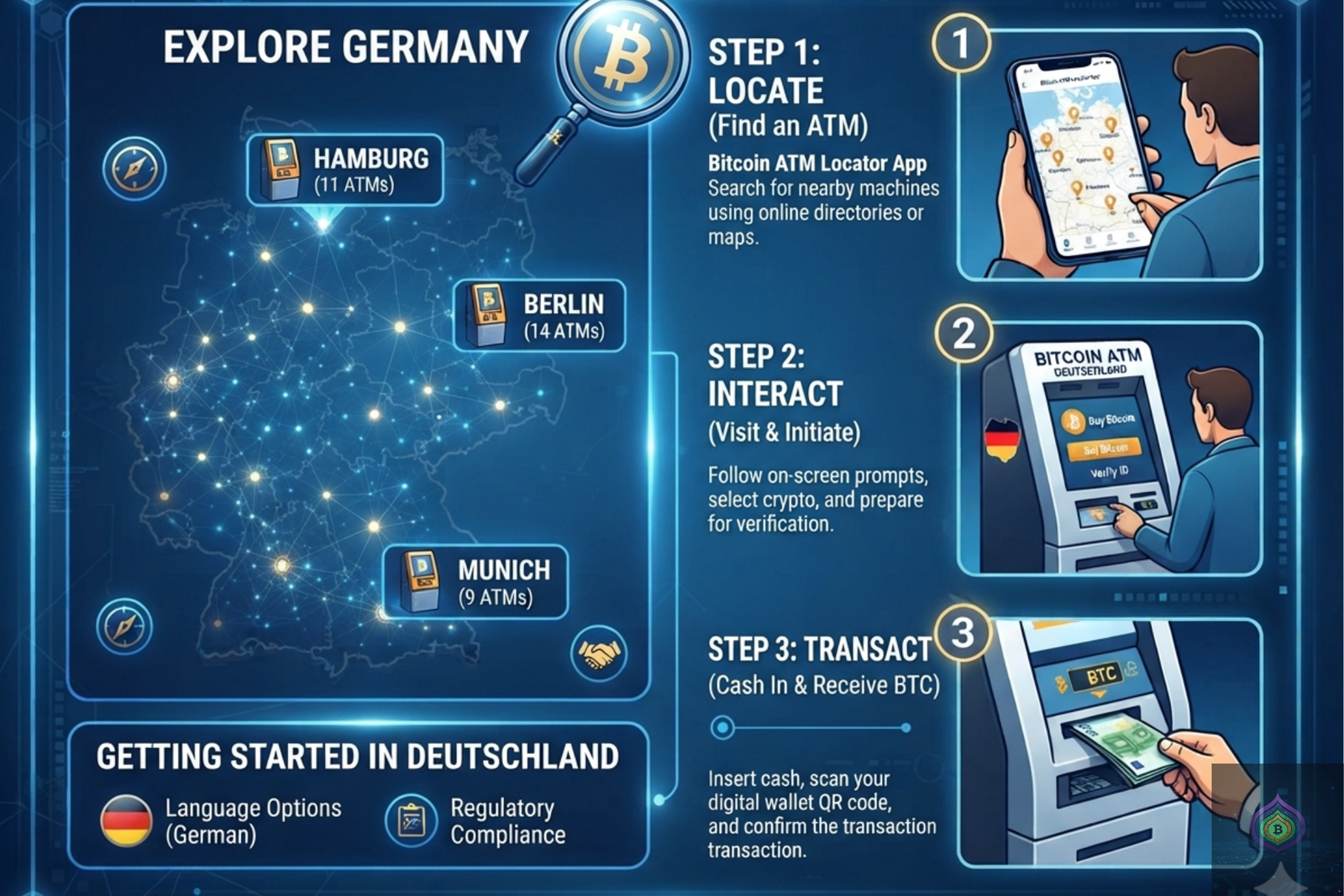
The most reliable tool for locating Bitcoin ATMs anywhere in Germany is CoinATMRadar.com — the world’s largest database of crypto ATM locations. Here’s how to use it effectively:
- Go to coinatmradar.com or download the CoinATMRadar mobile app (iOS and Android)
- Type your city, district, or postcode (Postleitzahl) into the search bar
- Filter results by cryptocurrency (Bitcoin), direction (buy or buy/sell), and operator if you have a preference
- Click on individual machines to see exact addresses, opening hours, fees, supported coins, and user reviews
- Use the map view to find the ATM closest to your current location
Other useful locator tools include Bitcoin.de (Germany’s largest peer-to-peer Bitcoin marketplace, which also lists ATM locations), Blockchair.com, and Google Maps (search “Bitcoin ATM near me” or “Bitcoin Automat” — the German term used locally). For the most up-to-date and comprehensive listings, CoinATMRadar remains the gold standard.
✅ Local Language Tip: When searching in German, use “Bitcoin Automat” or “Kryptowährungs-Automat” — these are the local terms used in search engines, signage, and local business listings. This can surface results that English-language searches miss.
Bitcoin ATMs by City: Germany’s Top 10 Locations
Here’s a city-by-city overview of estimated Bitcoin ATM presence across Germany’s largest urban centres. Note that counts and locations change frequently — always verify on CoinATMRadar before visiting:
| City | Est. ATM Count | Top Locations | Typical Fee Range |
| Berlin | 40+ | Mitte, Prenzlauer Berg, Friedrichshain | 5–10% |
| Hamburg | 15+ | Altona, HafenCity, city centre | 5–10% |
| Munich | 15+ | Maxvorstadt, Schwabing, central area | 5–9% |
| Frankfurt | 12+ | Sachsenhausen, Innenstadt, airport | 6–10% |
| Cologne | 10+ | City centre, Ehrenfeld, Deutz | 5–10% |
| Stuttgart | 8+ | City centre, Vaihingen | 6–10% |
| Leipzig | 8+ | Zentrum, Connewitz | 5–9% |
| Düsseldorf | 7+ | Altstadt, Düsseldorf centre | 6–10% |
| Nuremberg | 6+ | City centre, Langwasser | 5–9% |
| Dresden | 5+ | Neustadt, city centre | 6–10% |
Source: CoinATMRadar estimated data 2024. ATM counts are approximate and subject to change. Verify current availability before visiting any location.
Berlin: Germany’s Bitcoin ATM Capital
Berlin deserves special mention as Germany’s crypto capital. The city has long been at the forefront of European Bitcoin adoption — it was home to one of the world’s first Bitcoin-accepting businesses, and its tech-forward culture has made it a natural hub for crypto infrastructure.
Bitcoin ATMs in Berlin are concentrated in high-traffic neighbourhoods. You’ll find machines in Mitte (the central district), Prenzlauer Berg, Kreuzberg, and Friedrichshain. Many are located in 24-hour convenience stores, tobacconists (Tabakläden), and shopping arcades — meaning you can often buy Bitcoin outside of traditional business hours.
🏙️ Berlin Insider Tip: The area around Kottbusser Tor in Kreuzberg and the Hackescher Markt in Mitte historically have the highest concentration of crypto-friendly businesses and Bitcoin ATMs. If you’re in central Berlin, start your search there.
What to Expect: How German Bitcoin ATMs Work
If you’ve never used a Bitcoin ATM before, here’s exactly what to expect at a typical machine in Germany:
Step 1: Select Language
Most Bitcoin ATMs in Germany offer both German and English interfaces. Select your preferred language at the start screen.
Step 2: Choose Transaction Type
Select “Buy Bitcoin” (some machines also offer sell functionality — you can deposit BTC and receive cash). Most machines in Germany are buy-only, particularly the smaller kiosk-style units.
Step 3: Identity Verification (KYC)
This is where Germany differs from some other markets. Due to BaFin regulations and EU Anti-Money Laundering (AML) directives, most Bitcoin ATMs in Germany require some level of identity verification. The required level typically depends on the transaction amount:
- Under €1,000: Phone number verification (SMS code) is usually sufficient
- €1,000–€2,000: Government-issued ID scan (passport or national ID card) required
- Over €2,000: Full KYC including ID document and sometimes additional verification steps
Step 4: Scan Your Bitcoin Wallet QR Code
The machine will ask you to scan the QR code of your Bitcoin receiving wallet. Make sure you have a wallet app installed on your phone before you arrive — popular options in Germany include Electrum, Exodus, BlueWallet, or the Coinbase Wallet app. Always verify you’re scanning the correct receive address.
Step 5: Insert Cash
Insert your Euros into the cash slot in the denomination you wish to purchase. The machine will display the Bitcoin equivalent in real time, including fees. Review the final amount and the exchange rate carefully before confirming — fees can be significant (see below).
Step 6: Confirm and Receive
Confirm the transaction on screen. The Bitcoin is sent to your wallet address almost immediately — though depending on the machine and network conditions, you may receive a transaction confirmation in seconds or see the balance appear after 1–3 block confirmations (roughly 10–30 minutes).
⚠️ Bring Your Wallet and Phone: Never visit a Bitcoin ATM without a functioning Bitcoin wallet QR code ready on your phone. Most machines cannot print wallet receipts for you. If you don’t have a wallet set up, download a Bitcoin wallet app and generate a receiving address BEFORE going to the ATM.
Bitcoin ATM Fees in Germany: What You’ll Actually Pay
Here’s the honest reality: Bitcoin ATMs are a convenience product, and that convenience comes at a cost. Fees at German Bitcoin ATMs typically range from 5% to 12% per transaction — significantly higher than buying Bitcoin on an exchange. Understanding the fee structure helps you make an informed decision.
- Operator fee: The primary fee charged by the ATM operator, usually 5–10% above the market price
- Spread: Built-in price margin between the market rate and the ATM’s quoted rate — often an additional 1–3%
- Network (mining) fee: Small Bitcoin network fee for sending the transaction to your wallet — usually €0.50–€5 depending on network conditions
Always check the fee displayed on the machine screen before inserting cash. The best machines display a transparent breakdown. If a machine shows a “total fee” field without breaking down the components, be especially cautious — the effective cost to market price may be higher than the headline percentage suggests.
💡 Fee Comparison: Buying €500 of Bitcoin on Coinbase or Bitvavo costs approximately €6–€10 in fees. The same purchase at a Bitcoin ATM in Germany typically costs €25–€50 extra. ATMs make sense for speed and privacy — not for cost efficiency.
Smarter Alternatives If ATM Fees Are Too High
If the ATM fee stings, Germany has excellent regulated alternatives that provide faster and cheaper Bitcoin access than in most other European countries:
- Bitvavo: A Netherlands-based exchange popular in Germany with low fees (0.25% or less), SEPA bank transfers, and iDEAL — widely used by German residents for affordable Bitcoin purchases
- Bitcoin.de: Germany’s own Bitcoin marketplace — Europe’s oldest P2P Bitcoin exchange, established in 2011, regulated by BaFin, offering competitive rates with EUR SEPA transfers
- Coinbase: Fully licensed in Germany, supports SEPA bank transfers and debit card purchases, with a German-language interface
- Kraken: Has a European headquarters in Dublin and serves German customers directly, with SEPA transfer support and competitive fees
- Relai: A Switzerland-based Bitcoin-only app very popular in the German-speaking market (Germany, Austria, Switzerland) for simple, recurring DCA purchases
🇩🇪 Your Bitcoin Journey in Germany Starts Here
Germany is one of Europe’s most Bitcoin-friendly countries — with clear regulation, hundreds of ATMs in major cities, and a thriving community of crypto-native businesses. Whether you need Bitcoin fast at a local ATM or prefer the lower fees of a regulated exchange, the infrastructure is there.
The key is preparation: know where your nearest ATM is before you need it, have your wallet app ready on your phone, understand what the fees will be, and bring the right ID for your transaction size. With that preparation, buying Bitcoin in Germany is fast, legal, and straightforward.
- Bookmark CoinATMRadar.com or install the app to find your nearest ATM instantly.
- Set up your Bitcoin wallet (Electrum, BlueWallet, or Exodus) before visiting any ATM.
- Bring your passport or national ID card for transactions over €1,000.
- For regular purchases, compare ATM fees with Bitvavo or Bitcoin.de for significant savings.
👉 Share this guide with anyone in Germany looking to buy Bitcoin in person — because knowing exactly where to go and what to bring makes your first crypto experience smooth, fast, and stress-free.
Frequently Asked Questions
1. Do I need ID to use a Bitcoin ATM in Germany?
Yes — in most cases. Germany’s BaFin regulations and EU Anti-Money Laundering directives require Bitcoin ATM operators to implement Know Your Customer (KYC) procedures. For small transactions (generally under €1,000), a phone number verification via SMS is typically sufficient. For larger transactions (€1,000–€2,000+), you’ll need to scan a government-issued ID such as your passport or EU national identity card. Requirements vary by operator, so check the specific ATM’s requirements on CoinATMRadar before visiting.
2. What is the best Bitcoin ATM locator app for Germany?
CoinATMRadar (coinatmradar.com) is the most comprehensive and up-to-date Bitcoin ATM locator for Germany and globally. The free app (available on iOS and Android) shows real-time ATM locations, fees, operator information, supported cryptocurrencies, and user reviews. For a German-language alternative, Bitcoin.de also maintains ATM listings specifically relevant to the German market. Always verify a machine’s current operational status before making a special trip, as ATMs can go offline without notice.
3. How much does a Bitcoin ATM charge in Germany?
Bitcoin ATM fees in Germany typically range from 5% to 12% above the current market price, with most machines clustering around 7–10%. This is significantly higher than exchange trading fees. The fee is usually displayed transparently on the machine screen before you commit cash — always read the exchange rate and fee breakdown carefully before inserting money. Some machines also charge a flat network fee on top of the percentage, usually €1–€5, to cover Bitcoin blockchain transaction costs.
4. Can I sell Bitcoin at a German ATM and get cash back?
Some Bitcoin ATMs in Germany are bidirectional — meaning they allow you to both buy Bitcoin with cash AND sell Bitcoin to receive cash euros. However, bidirectional machines are less common than buy-only machines. On CoinATMRadar, filter your search by “Type: Two-Way” to find machines that support selling. The process involves sending Bitcoin to an address shown on the ATM screen and then receiving physical euro notes. The same KYC requirements apply to sell transactions as to purchases.
5. Is it legal to buy Bitcoin at an ATM in Germany?
Absolutely yes. Germany is one of Europe’s most crypto-friendly regulatory environments. Bitcoin has been recognized as a financial instrument (Rechnungseinheit — a unit of account) under German law since 2013. BaFin-regulated operators are legally permitted to operate Bitcoin ATMs, and purchasing Bitcoin from them is a fully legal activity for German residents and visitors. You will need to comply with the operator’s KYC requirements, and you may be required to report significant crypto gains to the Finanzamt (German tax authority) as part of your annual tax return if holdings exceed certain thresholds.